
How to open your own Uniswap v4 pool with a royalty on every swap
Anyone can open a Uniswap v4 pool on Robinhood Chain with LoomDesk's hook, for a tokenized stock or any other token, and set its rules once: the swap fee, what it pairs with, an optional launch fee and volatility fee, and a royalty, a share of every swap fee paid to you, whoever's liquidity the swap traded against. This guide goes through the hook builder block by block.
- What it costs
- 1 USDG once (0.0004 ETH for an ETH pair), plus gas.
- The royalty
- Up to 30% of the swap fee, to the wallet that opened the pool, in the paired asset, on every swap.
- Who can add liquidity
- Anyone. The hook never locks liquidity and never refuses a trade.
- What can change later
- The fee only if you chose a Managed fee, and only by you. LoomDesk cannot move it.
Open the builder
Go to Create hook, or use the Create your own hook card on any token's page. The builder draws the pool in the middle and its parts around it, and shows, as you change them, what a swap will pay and to whom.
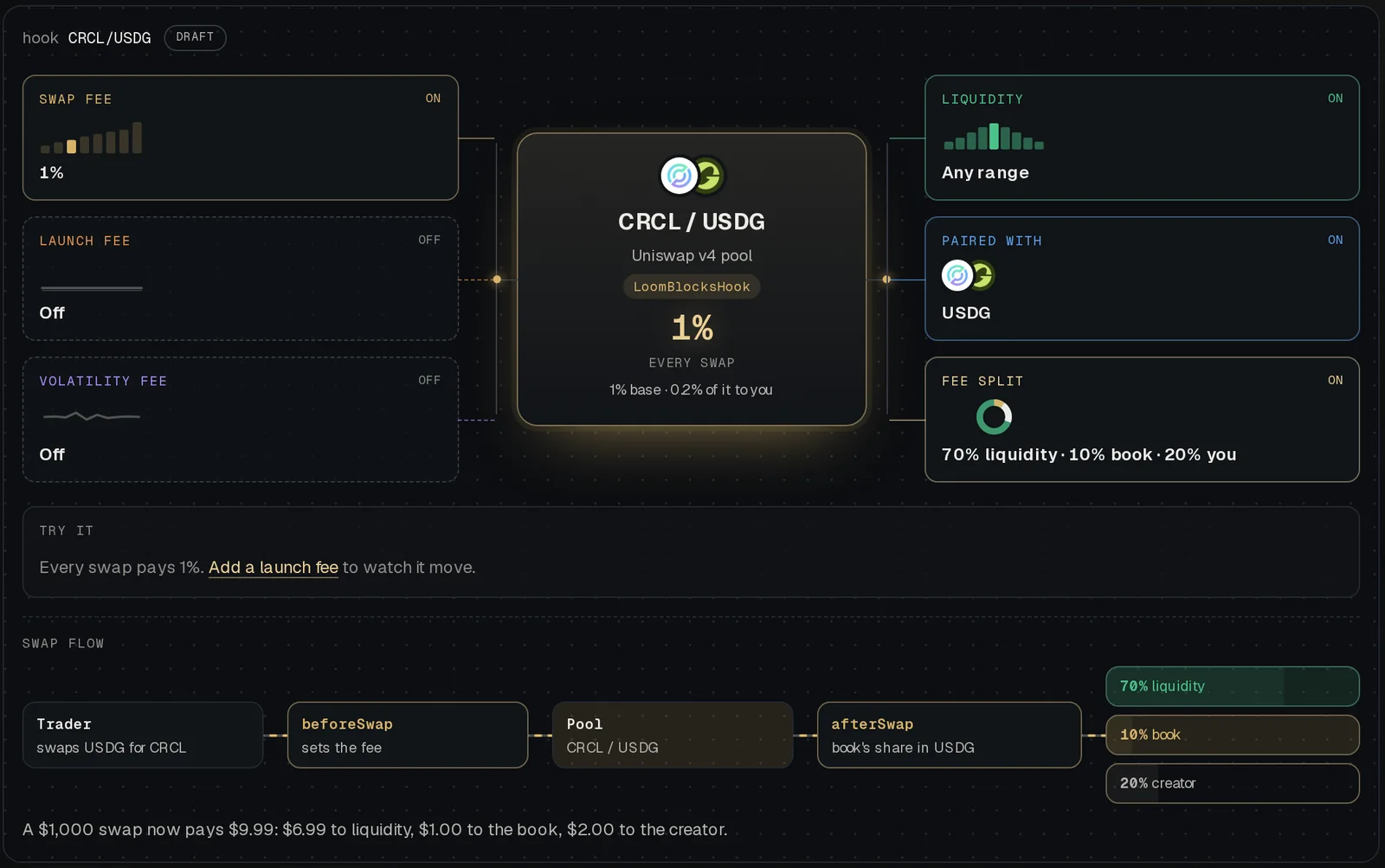
Start from a preset
- Token launch: 5%, a 50% launch fee for an hour, volatility fee on.
- Volatile: 3%, more while the price moves fast.
- Steady: 1% on every swap. A sensible start for a stock.
- Full range: 1% taken in the paired asset, and arbitrage pays the gap to the market.
Every part can then be changed by hand.
The parts of a pool
Liquidity
Any range takes ladders and limit orders, and fees are paid in whichever token a trader pays with. Full range holds one position across every price, with fees in the paired asset. The blocks below, the royalty among them, are for Any range pools.
Paired with
ETH, USDG, LOOM, a stock, or any token.
Swap fee
0.1%, 0.5%, 1%, 2%, 3%, 4% or 5%. It also sets the price step: 0.1% pools move in the finest steps, 1% to 5% pools in steps of about 2%, so their rungs are at least 2% wide.
Launch fee
Off, or a higher fee for the first minutes: 10% for 10 minutes, 30% for 30 minutes or 50% for an hour. It falls in a straight line to the swap fee over that time, and all of the extra goes to liquidity. It suits a token that is new to the market more than a stock.
Volatility fee
On, and swaps pay more while the price moves fast. The extra goes to liquidity too.
The blocks
- Anti-snipe: for the first minutes, no single buy may spend more than a set amount of the paired asset.
- Royalty: a share of the swap fee, up to 30%, paid to you in the paired asset on every swap.
- Auto burn: on every sell, up to 20% of the swap fee is taken in the token and burned.
- Managed fee: you may move the swap fee between a floor and a ceiling you set now, at most once an hour.
- Market hours: outside NYSE trading hours the pool charges a different fee, set now.
Market hours are weekdays from 13:30 to 20:00 UTC; LoomDesk moves them to 14:30 to 21:00 when US clocks change for winter. The hook does not know market holidays. Managed fee and Market hours need a swap fee of 1% to 5%: those fees share one price step, so a pool can move between them.
Who gets what from a swap
A trader always pays the pool's fee and no more. Out of it, 10% goes to the LoomDesk book, your royalty goes to you, and liquidity gets the rest, plus all of what the launch and volatility fees add. So the royalty does not cost traders anything extra: it comes out of liquidity's share. With a 20% royalty, liquidity earns 70% of the fee instead of 90%, which matters if you want other people to provide liquidity in your pool.
What can never change, and what can
- The swap fee is fixed. With Managed fee on, only you can move it, inside your floor and ceiling.
- The royalty, the burn, the launch fee and the blocks are set when the pool opens. The royalty always goes to the wallet that opened the pool.
- No block ever refuses a trade, and the hook has no say over adding or removing liquidity.
- LoomDesk cannot move a pool's fee. It does keep a few settings for the whole hook: the book's share of the fee (10% today, never more than 30%), how the volatility fee responds to price moves, and the market-hours clock.
One pool per pair and price step
A pair can have one pool on the hook at 0.1%, one at 0.5% and one for 1% to 5%. If the one you want already exists, the builder says Taken: you can provide liquidity to that pool instead, but its royalty belongs to whoever opened it.
After you open it
A new pool starts empty. To give it a market, provide liquidity yourself, the same way as in any pool (step by step). Trades arrive when routers find your price better than elsewhere, and from arbitrage when the token's main market moves by more than your fee. For a stock, think about nights and weekends: what happens to stock pools when Wall Street is closed, and why Market hours exists.
Questions
Do I have to provide liquidity in my own pool?
No, but an empty pool has no trades and pays no royalty. Someone has to provide liquidity first, and that is usually the pool's creator.
Who receives the royalty?
The wallet that opened the pool, in the paired asset (USDG for a USDG pair), on every swap. It cannot be moved to another wallet later.
Can I change the royalty later?
No. It is set when the pool opens, like the burn and the launch fee.
What does it cost?
1 USDG once, or 0.0004 ETH when the pool pairs with ETH, plus gas. Adding liquidity afterwards costs the usual 0.25% to open a position.