
Uniswap v3 vs v4 pools: which one pays liquidity providers more?
Most tokenized stocks on Robinhood Chain trade in several pools at once: an older Uniswap v3 pool and a few Uniswap v4 pools, some of them with hooks. LoomDesk builds positions in both kinds. Which one pays a liquidity provider more is not a question of version. It comes down to a few numbers the pool picker shows, and one the marketplace shows.
- Short answer
- Neither, by default. What pays is volume through your range against the liquidity already there, the fee rate, and what the pool keeps after the price moves.
- What v4 adds
- Any fee, fees that change per swap, and hooks: code that runs on every swap.
- What to check
- Fees in dollars, depth, the price step, Keeps, and in v4 what the hook does.
What v3 and v4 have in common
Both are concentrated liquidity: you choose a price range, your money trades only while the price is inside it, and the swap fee is shared among the liquidity at the current price in proportion to its size. In both, a position is an NFT. On LoomDesk a position is a ladder of narrow ranges (rungs), and each rung is one such NFT, in a v3 pool or a v4 pool alike.
What Uniswap v4 changes
- The fee. A v3 pool charges one of a handful of fixed tiers, such as 0.05%, 0.3% or 1%. A v4 pool can charge any fee, and with a hook the fee can change from one swap to the next: the picker shows such a pool as, for example, 0.23% avg.
- Hooks. A hook is code that runs on every swap. It can add a launch fee for a new token, raise the fee while the price moves fast, pay a royalty to the pool's creator or burn part of the fee. It can also keep the whole fee, refuse liquidity from anyone else, or make a token impossible to sell. A v4 pool is only as good as its hook.
- One contract for every pool. All v4 pools live in a single PoolManager, and a pool can pair native ETH directly instead of WETH.
LoomDesk lists only the pools a position can be built in: a pool whose hook refuses outside liquidity stays out of the builder, and every listed pool is sell-tested. A pool whose hook keeps every swap fee is marked No fees to liquidity; a position there still buys under the price and sells over it, but earns nothing on top.
Read the picker, not the version
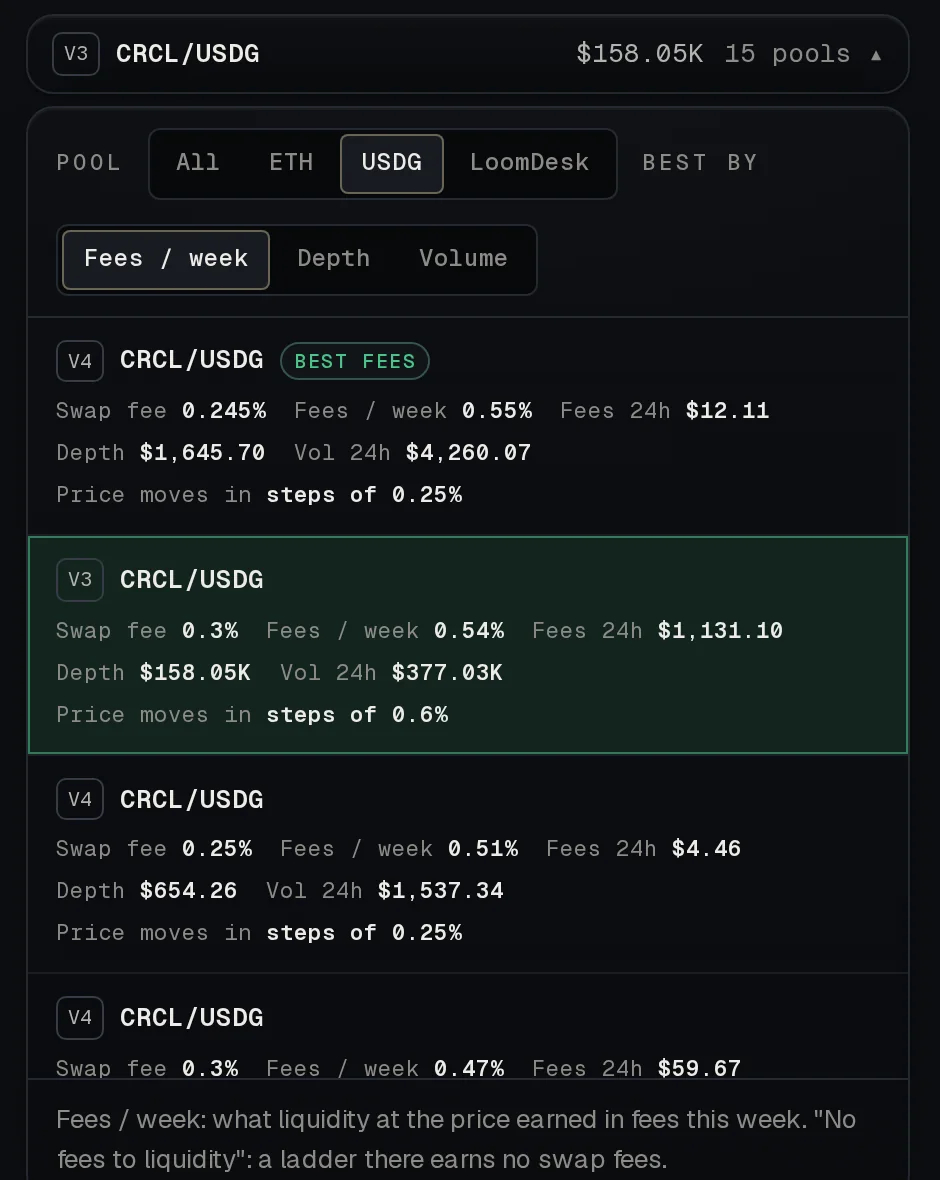
Here are two of CRCL's USDG pools as the pool picker showed them on Saturday 10 October 2026, ranked by fees per week:
| Uniswap v4 | Uniswap v3 | |
|---|---|---|
| Swap fee | 0.245% | 0.3% |
| Fees / week | 0.55% | 0.54% |
| Fees 24h | $12.11 | $1,131.10 |
| Volume 24h | $4,260.07 | $377.03K |
| Depth | $1,645.70 | $158.05K |
| Price step | 0.25% | 0.6% |
The v4 pool tops the ranking, and per dollar of liquidity at the price the two earned almost the same that week. But the v3 pool is about 96 times deeper and paid about 93 times more in fees that day.
That difference is what decides it for you. Fees per week is a rate measured before you join. Put $1,000 into a pool with $1,646 of depth and you become a large part of the liquidity at the price, so the same fees are shared with your money and the rate falls for everyone, you included. Put it into the pool with $158K of depth and the rate barely moves. The v4 pool's finer price step lets rungs be narrower; that matters for a tight range and little for a wide one.
The number the picker cannot show: what a pool keeps
Fees are only half of a liquidity provider's result. When the price moves in one direction, arbitrage trades the pool to the new price, and the liquidity on the losing side of those trades gives up value. The marketplace measures this as Keeps: the share of its fees a token's busiest pool held on to after the price moved.
On the stocks list of 10 October 2026, GLD's pool kept 78%, USO's 76%, META's 70% and GOOGL's 68%. SPY's kept 35%, CRCL's 27%, MSTR's 15%, NVDA's 9% and HIMS's none. A pool with big fees and a low Keeps paid its liquidity providers less than the fees suggest.
A checklist for choosing a pool
- Fees in dollars, not only the rate. Compare fees 24h with the size you will bring.
- Depth. The deeper the pool, the less your money dilutes its rate and the less one trade moves its price.
- Keeps. A pool that keeps most of its fees is one where the price mostly goes back and forth.
- The price step. It sets how narrow a rung can be.
- In v4, the hook. On a token's page, a pool's protocol fee row says what its hook or exchange keeps before liquidity is paid.
Moving a position between v3 and v4
A position belongs to its pool. To move it, close it (one transaction) and open a new one in the other pool, paying the 0.25% opening fee again. The step by step guide covers both.
Questions
Is a v4 pool riskier than a v3 pool?
Only as risky as its hook. Without a hook, a v4 pool behaves like a v3 pool with a free choice of fee. With one, read what the hook does to fees, to liquidity and to selling.
Does LoomDesk take part of a pool's fee?
In pools opened on LoomDesk's own hook, 10% of the swap fee goes to the LoomDesk book. In other pools LoomDesk takes nothing from the pool; what a position pays is the 0.25% opening fee and 5% of the fees it collects.
What are LoomDesk's own pools?
Uniswap v4 pools on LoomDesk's hook, opened by anyone with the hook builder: a fee of 0.1% to 5%, optional launch and volatility fees, and a royalty for the creator if they want one.