
Closing a liquidity position: a real CRCL position, to the cent
Guides to liquidity usually stop at opening a position. This one is about the other end. On 9 October 2026 we opened a small position in CRCL's deepest pool from LoomDesk's own test wallet, and closed it 35 minutes later. Below is what went in, what came back, what it earned, and how it compares with simply holding, with both transactions on the explorer so every number can be checked.
- Put in
- 1.5 USDG and 0.0281 CRCL, worth $3.77
- Came back
- 2.9733 USDG and 0.0103 CRCL, worth $3.84, fees included
- Result
- +$0.066 (+1.74%) in 35 minutes, and $0.023 behind holding
- Transactions
- one to open, 0x67ea…8459; one to close, 0x994a…23e0
The position
- Pool: CRCL/USDG, Uniswap v3, 0.3% fee, the deepest CRCL pool on Robinhood Chain.
- Range: $76.26 to $84.96, about 5% either side of the price, in the Spot shape.
- Rungs: 12, each its own Uniswap v3 position NFT, numbers 1417801 to 1417812.
- Opened: 9 October 2026 at 13:38 UTC, block 84,197,627. CRCL was at $80.77 in the pool. 0.03 CRCL was offered; the rungs took 0.0281 and the rest came straight back in the same transaction.
- Cost to open: the 0.25% opening fee, 0.0094 USDG, and about 0.0001 ETH of gas (about $0.27).
It is a tiny position on purpose: the point is the arithmetic, which is the same at any size. Gas is the one cost that does not scale; on a position of a few hundred dollars it is a rounding error.
How it was closed
- On CRCL's page, under Positions, the row's Manage button opens the position's panel.
- In the Withdraw tab: how much, 100%; receive as, USDG and CRCL as they are.
- The panel shows what will come out: 0.0103 CRCL and 2.9696 USDG, about $3.83, plus the fees waiting.
- Close position, then confirm in the wallet.
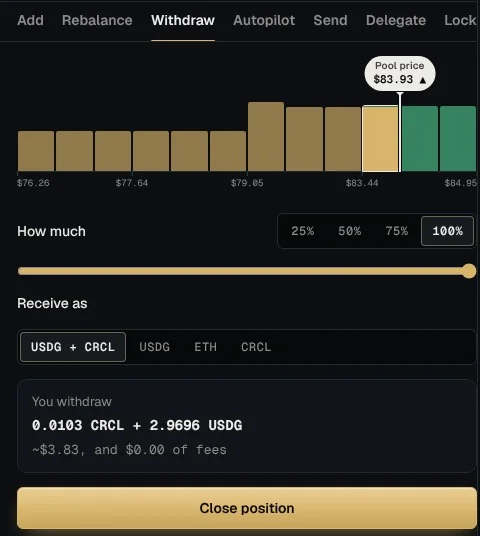
That one transaction collected the fees, removed every rung, burned the 12 NFTs and sent everything to the wallet, at 14:13 UTC in block 84,218,439. Gas: about 0.00005 ETH (about $0.13).
What came back
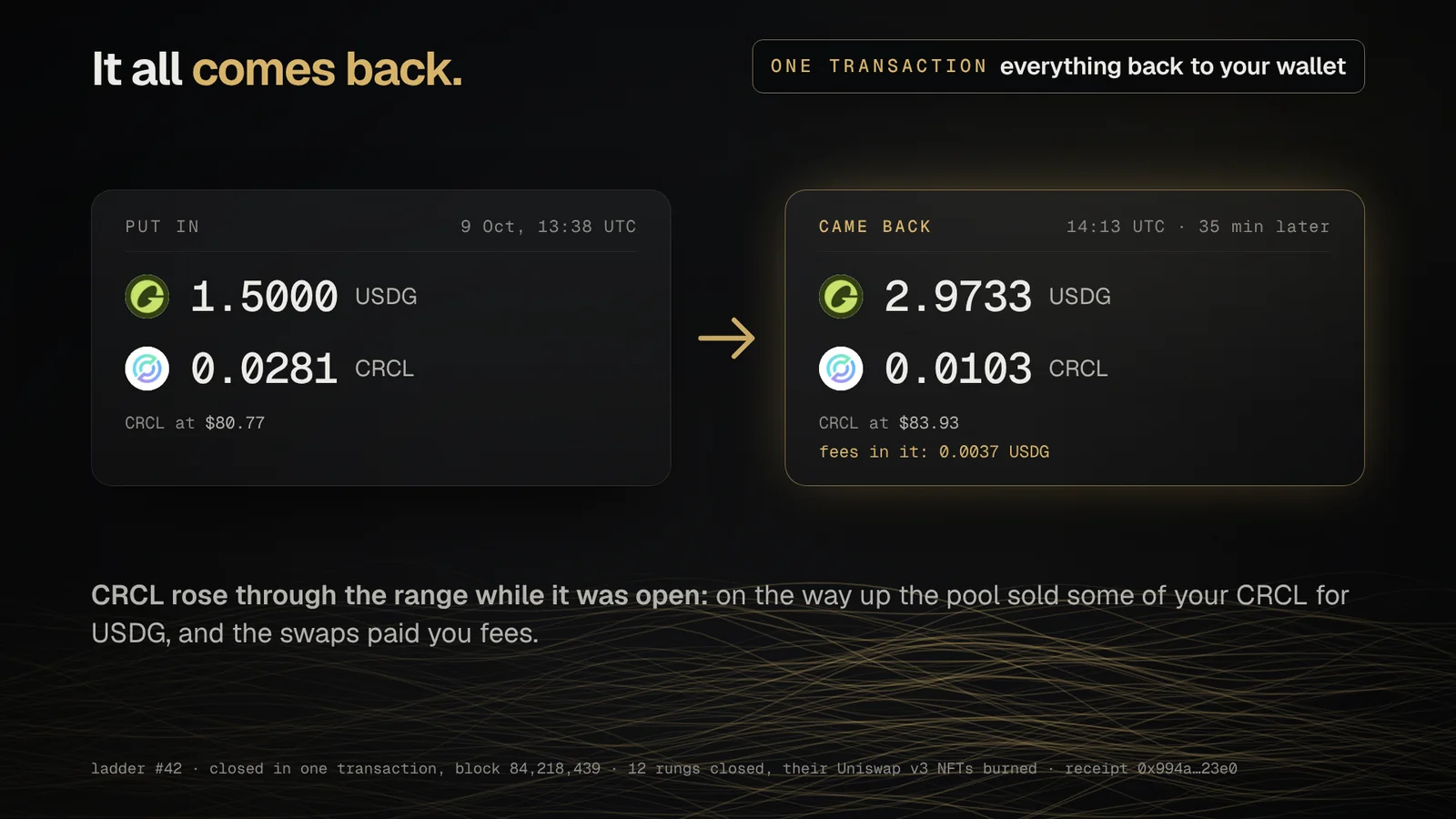
2.9733 USDG and 0.0103 CRCL. Of that, the fees were 0.0037 USDG and a sliver of CRCL, after LoomDesk's 5%. Nothing was taken of the gain. At $83.93 a CRCL, the whole is worth $3.84 against $3.77 put in: +$0.066, or +1.74%. The position's card on LoomDesk shows the same figure.
And against simply holding
Had the 1.5 USDG and 0.0281 CRCL stayed in the wallet, they would have been worth $3.86 at the same moment. The position ended $0.023 behind holding. The Academy splits a result into three parts that add up to it:
| Price move | +$0.089 | what holding what went in made: CRCL rose 3.9% |
|---|---|---|
| Trading | −$0.027 | what the rungs gave up by selling CRCL as it rose, the $0.009 opening fee included |
| Fees | +$0.004 | what 35 minutes of swaps paid the position |
| Result | +$0.066 | against $3.77 put in |
This is how a range position behaves when the price runs one way. As CRCL climbed through the band, the rungs over the price sold it for USDG, which is why the position came back with twice the USDG and a third of the CRCL it started with. It took part in the rise, but less than holding did. Over 35 minutes the fees could not make that up. Over days of a price moving back and forth inside the band, they can: each crossing pays a fee and the round trip costs nothing.
Other ways out
- Claim fees takes only the fees and leaves the position working.
- Partial withdraw takes a share of every rung out, 25%, 50%, 75% or any share on the slider, and leaves the rest working.
- Receive as one asset pays it all out as USDG, ETH or the stock, sold on the way out at the pool's price, with your slippage setting as the floor.
- Close all on the Positions tab closes every position you hold on that page.
Questions
How long does closing take?
One transaction. On Robinhood Chain it confirms in seconds.
Can I close a position that is out of range?
Yes. It then holds only one asset, all USDG if the price rose past the top, all of the stock if it fell past the bottom, and that is what comes back.
Does LoomDesk take a share of my gain when I close?
Not on positions opened since 30 September 2026. It takes 5% of the fees you collect, and the 0.25% opening fee; positions on older contracts pay 5% of a gain.
Why did the position earn less than holding?
Because the price rose steadily through the range, and a range position sells as the price rises. It does best when the price moves back and forth inside its band.
Ready to open one? How to provide liquidity to tokenized stocks, step by step.